← Back to results
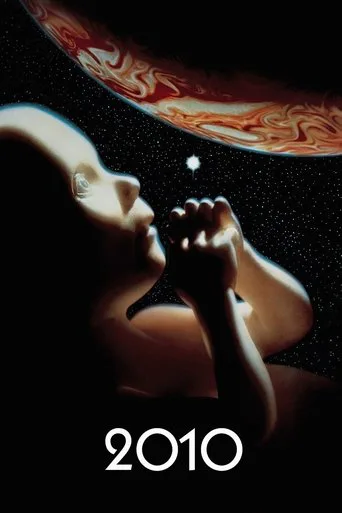
2010
1984 116 min United States of America PG 16+
★6.9
Thriller, Science Fiction
Director: Peter Hyams
🎭 Based on
«2010: Odyssey Two»
byArthur C. Clarke
Trailers
 EN
EN
 EN
EN
 EN
EN
 EN
EN
 EN
EN
 EN
EN
 EN
EN
 EN
EN
Description
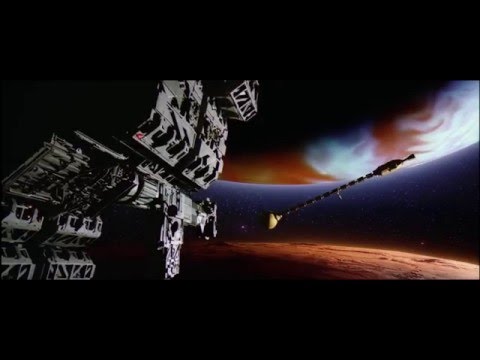
While planet Earth poises on the brink of nuclear self-destruction, a team of Russian and American scientists aboard the Leonov hurtles to a rendezvous with the still-orbiting Discovery spacecraft and its sole known survivor, the homicidal computer HAL.
Budget:
$28M
US Gross:
$40.4M
Worldwide:
$40.4M
Starring
Roy Scheider
Actor
John Lithgow
Actor
Helen Mirren
Actor
Awards
Academy Awards 1985
— Best Production Design
Academy Awards 1985
— Best Sound
Academy Awards 1985
— Best Makeup and Hairstyling
Academy Awards 1985
— Best Visual Effects
Saturn Awards 1985
— Best Costume Design
Saturn Awards 1985
— Best Science Fiction Film
Academy Awards 1985
— Best Costume Design
Saturn Awards 1985
— Best Visual Effects
Key opinion
2010: The Year We Make Contact is generally viewed as a competent, narrative-driven space adventure that successfully answers many of the mysteries left by its predecessor. While it is widely acknowledged that the film fails to reach the artistic or philosophical heights of Kubrick's original, it is often appreciated by fans of Arthur C. Clarke's writing as a logical and engaging sequel.
| Screenplay | The film effectively resolves lingering narrative questions from the original while moving away from its predecessor's abstract and symbolic tone. | |
| Acting | The cast, including Roy Scheider and Helen Mirren, delivers solid performances that provide the film with a grounded, human element. | |
| Production | The technical production and visual effects are perceived as a significant step down from the high standard set by the 1968 original, leading to a more conventional, "TV-like" aesthetic. | |
| Pacing | Opinions on pacing are divided: some appreciate the faster, more straightforward narrative movement, while others find the film dull or monotonous compared to the immersive atmosphere of the first movie. | |
| Culture | The depiction of Cold War tensions and Soviet-American cooperation oscillates between being seen as a realistic, grounded plot device and being criticized as either dated or inaccurately portrayed. | |
| Ending | The film’s climax and thematic resolution are polarizing; supporters find them satisfying and logical, while detractors view them as naive or contrived. |