← Back to results
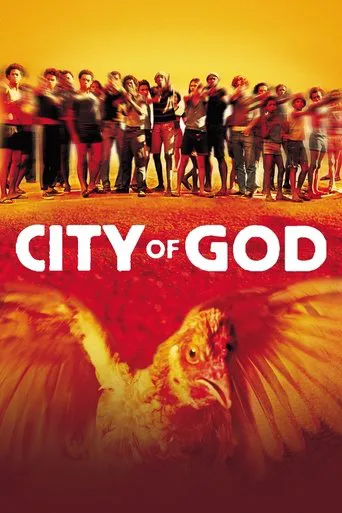
City of God
Cidade de Deus
2002 129 min Brazil, France, Germany R 16+
★8.7
Drama, Crime
Director: Kátia Lund, Fernando Meirelles
🎭 Based on
«City of God»
byPaulo Lins
Trailers

Description
In the poverty-stricken favelas of Rio de Janeiro in the 1970s, two young men choose different paths. Rocket is a budding photographer who documents the increasing drug-related violence of his neighborhood, while José “Zé” Pequeno is an ambitious drug dealer diving into a dangerous life of crime.
Budget:
$3.3M
US Gross:
$7.56M
Worldwide:
$30.64M
Starring
Alexandre Rodrigues
Actor
Leandro Firmino
Actor
Matheus Nachtergaele
Actor
Awards
BAFTA 2003
— Best Film Editing
Academy Awards 2004
— Best Cinematography
Golden Globe 2003
— Best International Feature Film
Academy Awards 2004
— Best Director
Academy Awards 2004
— Best Film Editing
BAFTA 2003
— Best Film Editing
BAFTA 2003
— Best International Feature Film
European Film Awards 2002
— Screen International Award
Key opinion
City of God is widely celebrated as a visceral, groundbreaking crime drama that rejects the romanticization of poverty in favor of a raw, documentary-style exploration of life in Rio's favelas. While its unflinching depiction of childhood violence and systemic brutality is harrowing, the film is consistently praised for its authentic performances and bold, kinetic direction.
| Acting | The use of non-professional, local actors creates a sense of raw, authentic performance that anchors the film's gritty atmosphere. | |
| Cinematography | The kinetic, high-energy cinematography and editing style capture the chaotic, predatory nature of life in the favela with a unique visual identity. | |
| Screenplay | The non-linear, fragmented screenplay successfully weaves together multiple character arcs to expose the cyclical nature of violence in the slums. | |
| Emotion | The film’s brutal, unrelenting realism is a massive strength for those seeking an unfiltered social portrait, but the lack of traditional sentimentality or hope leaves some viewers feeling alienated or emotionally detached. | |
| Direction | The stylistic flourishes and rapid pace are hailed as a masterclass in direction by most, yet some find the relentless, spectacle-free focus on cyclical violence monotonous or predictable. |