Trailers
Description
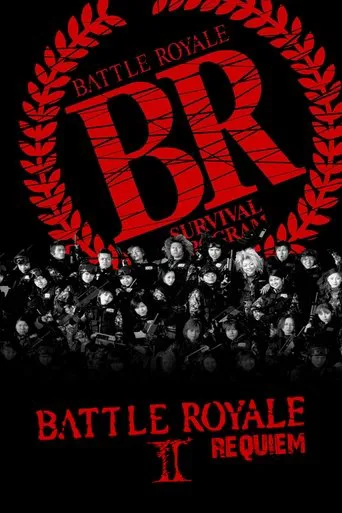
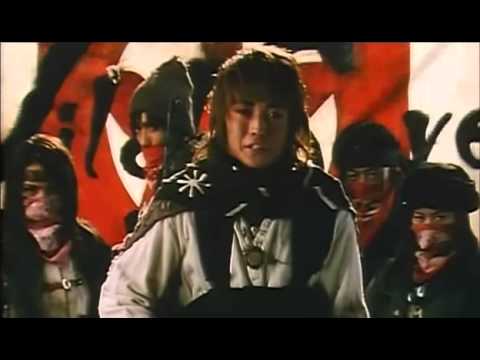
It's three years after the events of the original Battle Royale, and Shuya Nanahara is now an internationally-known terrorist determined to bring down the government. His terrorist group, Wild Seven, stages an attack that levels several buildings in Tokyo on Christmas Day, killing 8000 people. In order for the government to study the benefits of "teamwork", the new students work in pairs, with their collars electronically linked so that if one of them is killed, the other dies as well. They must kill Nanahara in three days - or die.
Starring
Awards
Key opinion
Battle Royale II is widely considered a disappointing and disjointed sequel that abandons the psychological nuance of its predecessor in favor of repetitive, gratuitous action. While a small subset of viewers appreciates its bold political messaging and war-drama aesthetic, the general consensus is that the film suffers from poor writing, inconsistent character logic, and a failure to replicate the original's impact.
| Originality | The film discards the psychological tension and character-driven conflict of the original in favor of relentless, hollow spectacle. | |
| Screenplay | The premise of an all-out war between youth and adults is hampered by narrative gaps, illogical character motivations, and a lack of coherent plot progression. | |
| Acting | The absence of Takeshi Kitano's commanding presence leaves a void that the new, caricature-like instructor fails to fill. | |
| Theme | The shift toward an anti-American, anti-establishment political manifesto divides viewers between those who find the messaging daring and those who view it as a thin, poorly executed political tract. | |
| Pacing | The near-constant, explosive action and war-film aesthetic are seen by some as an exciting shift in tone, while others describe it as exhausting, redundant, and poorly filmed. |