← Back to results
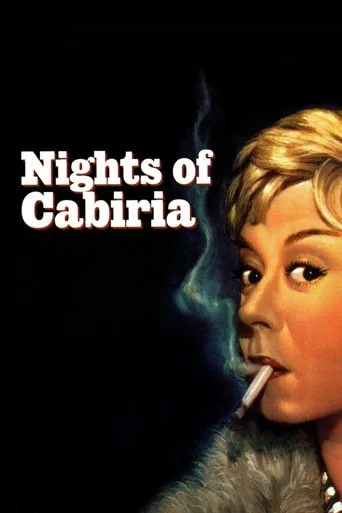
Nights of Cabiria
Le notti di Cabiria
1957 110 min Italy, France 18+
★8.8
Drama, Comedy
Director: Federico Fellini
Trailers
 EN
EN
 EN
EN
 EN
EN
 EN
EN
 EN
EN
Description
Rome, 1957. A woman, Cabiria, is robbed and left to drown by her boyfriend, Giorgio. Rescued, she resumes her life and tries her best to find happiness in a cynical world. Even when she thinks her struggles are over and she has found happiness and contentment, things may not be what they seem.
US Gross:
$766,530
Worldwide:
$752,045
Starring
Giulietta Masina
Actor
François Périer
Actor
Franca Marzi
Actor
Awards
Cannes Film Festival 1957
— Silver Award – Best Actress
San Sebastián International Film Festival 1957
— Zulueta Prize – Best Actress
Academy Awards 1958
— Best International Feature Film
Cannes Film Festival 1957
— Silver Award – Best Actress
San Sebastián International Film Festival 1957
— Zulueta Prize – Best Actress
Academy Awards 1958
— Best International Feature Film
Cannes Film Festival 1957
— OCIC Award
Key opinion
Nights of Cabiria is widely regarded as a masterful, emotionally resonant portrait of resilience, anchored by Giulietta Masina’s iconic performance as the eternally hopeful Cabiria. While the film captures the bleakness of post-war Rome and the exploitation of its protagonist, it is celebrated for its humanistic spirit and its refusal to succumb to cynical despair.
| Acting | Giulietta Masina’s expressive and layered performance is the essential heart of the film, perfectly capturing both the character's childlike vulnerability and her fierce, persistent resilience. | |
| Direction | Fellini’s direction masterfully contrasts the harsh realities of the Roman underworld with the character's internal purity and unwavering faith in humanity. | |
| Theme | The narrative effectively explores the tension between external filth and the heroine's protected, essential innocence, elevated by its refusal to fall into simple sentimentality. | |
| Pacing | The film’s pacing is viewed by most as a contemplative and engaging reflection of the protagonist's journey, though a minority find the narrative progression and editing to be disjointed or obscure. |