← Back to results
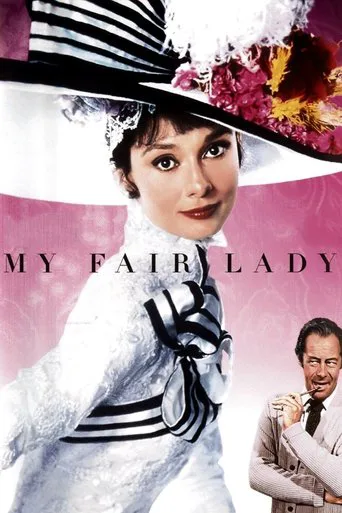
My Fair Lady
1964 170 min United States of America G 12+
★8.7
Comedy, Romance
Director: George Cukor
🎭 Based on
«Pygmalion»
byGeorge Bernard Shaw
Trailers
 EN
EN
 EN
EN
 EN
EN
 EN
EN
 EN
EN
 EN
EN
 Teaser
 Teaser
 EN
EN
 EN
EN
 EN
EN
 EN
EN
Description
A snobbish phonetics professor agrees to a wager that he can take a flower girl and make her presentable in high society.
Budget:
$17M
US Gross:
$72.56M
Worldwide:
$72.66M
Starring
Audrey Hepburn
Actor
Rex Harrison
Actor
Stanley Holloway
Actor
Awards
Academy Awards 1965
— Best Production Design (Color)
Academy Awards 1965
— Best Costume Design (Color)
Golden Globe 1965
— Best Actor (Comedy or Musical)
Academy Awards 1965
— Best Actor
Academy Awards 1965
— Best Film Editing
Golden Globe 1965
— Best Picture (Comedy or Musical)
Academy Awards 1965
— Best Sound
Academy Awards 1965
— Best Supporting Actor
Academy Awards 1965
— Best Adapted Screenplay
Academy Awards 1965
— Best Picture
Academy Awards 1965
— Best Supporting Actress
Academy Awards 1965
— Best Director
BAFTA 1966
— Best Picture
BAFTA 1966
— Best British Actor
Academy Awards 1965
— Best Cinematography (Color)
Academy Awards 1965
— Best Musical Adaptation
Golden Globe 1965
— Best Supporting Actor
Golden Globe 1965
— Best Director
Golden Globe 1965
— Best Actress (Comedy or Musical)
Key opinion
My Fair Lady is widely celebrated as a visually stunning and musically accomplished masterpiece of 1960s cinema. While its production values and performances are lauded, the film remains a subject of debate regarding the casting of Audrey Hepburn and the problematic gender dynamics inherent in its source material.
| Production | The production design, including the lavish costumes and sets, is universally praised as spectacular and visually immersive. | |
| Score | The Lerner and Loewe musical score is regarded as a quintessential strength, providing memorable and emotionally resonant songs. | |
| Acting | Rex Harrison’s performance as Professor Henry Higgins is lauded for its complexity, effectively capturing both the character's intellectual arrogance and his eventual human vulnerability. | |
| Runtime | The film's lengthy 170-minute runtime is a point of contention: supporters view it as a necessary element of a grand, theatrical experience, while critics find the pacing to be overly slow and exhausting. | |
| Acting | Audrey Hepburn's casting as Eliza Doolittle divides audiences; proponents admire her transformative charm and beauty, while detractors feel her aristocratic presence makes her portrayal of an unrefined flower girl feel unnatural. | |
| Acting | The decision to dub Audrey Hepburn's singing voice with Marni Nixon remains a point of criticism, with some viewers feeling it detracted from the performance's authenticity, despite the technical quality of the vocals. | |
| Theme | The screenplay's thematic portrayal of Professor Higgins's chauvinism and the manipulation of Eliza is viewed by some as a charming romantic comedy, while others find the underlying premise to be misogynistic and ethically problematic. |