← Back to results
Places in the Heart
1984 111 min United States of America PG 6+
★8.0
Drama
Director: Robert Benton
Trailers

 EN
EN
 EN
EN
Description
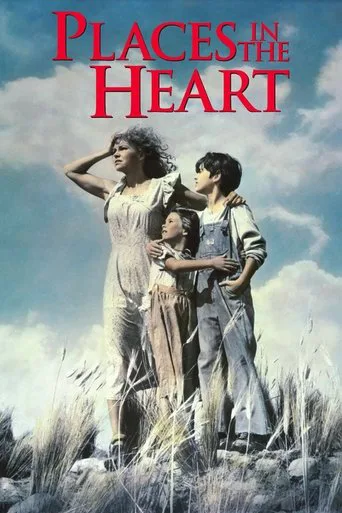
In 1935 rural Texas, recently widowed Edna Spaulding struggles to survive with two small children, a farm to run, and very little money in the bank - not to mention a deadly tornado and the unwelcome presence of the Ku Klux Klan. Edna is aided by her beautician sister, Margaret; a blind boarder, Mr. Will; and a would-be thief, Moze, who decides to teach Edna how to plant and harvest cotton.
Budget:
$9.5M
US Gross:
$34.9M
Worldwide:
$34.9M
Starring
Sally Field
Actor
Lindsay Crouse
Actor
Ed Harris
Actor
Awards
Academy Awards 1985
— Best Actress
Academy Awards 1985
— Best Screenplay
Berlin International Film Festival 1985
— Silver Bear – Best Director
Academy Awards 1985
— Best Supporting Actress
Berlin International Film Festival 1985
— Golden Bear
Academy Awards 1985
— Best Supporting Actor
Academy Awards 1985
— Best Director
Academy Awards 1985
— Best Costume Design
Golden Globe 1985
— Best Actress (Drama)
Golden Globe 1985
— Best Screenplay
Academy Awards 1985
— Best Picture
Golden Globe 1985
— Best Picture (Drama)
Berlin International Film Festival 1985
— OCIC Award (Competition)
Key opinion
Places in the Heart is widely regarded as a poignant and authentic drama that captures the struggles of the Great Depression through a lens of communal resilience. Critics and audiences alike praise the strong central performances and the director's grounded, evocative approach to life in rural Texas.
| Acting | Sally Field delivers a masterful and emotionally resonant performance that serves as the film's anchor. | |
| Direction | Robert Benton provides steady, naturalistic direction that eschews romanticism for a raw depiction of the era. | |
| Acting | The ensemble cast, including Danny Glover and John Malkovich, brings an exceptional level of talent that elevates the character dynamics. | |
| Cinematography | Nestor Almendros’s precise cinematography perfectly balances the intimacy of domestic scenes with the broader struggle of rural life. | |
| Screenplay | The screenplay effectively weaves together complex social issues like racial segregation and economic survival into a cohesive, universal narrative. | |
| Theme | The film's quiet, communal rhythm is viewed by some as a nostalgic, life-affirming look at a bygone era, while others find its depiction of vanishing values subtly haunting. |