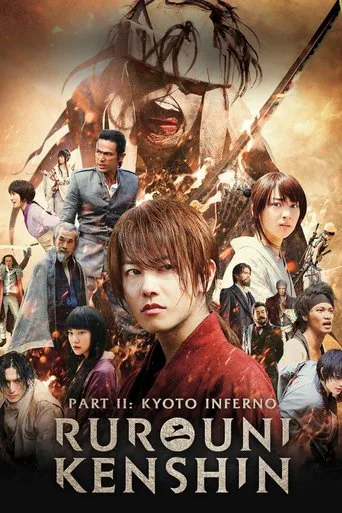
Trailers
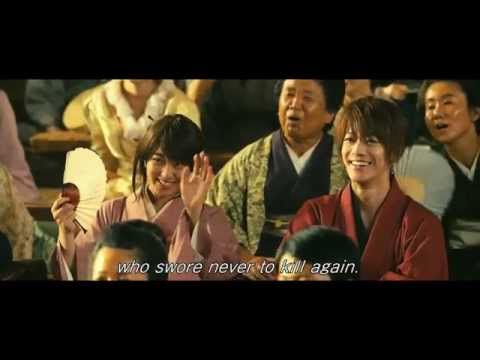
Description
Kenshin has settled into his new life with Kaoru and his other friends when he is approached with a request from the Meiji government. Makoto Shishio, a former assassin like Kenshin, was betrayed, set on fire and left for dead. He survived, and is now in Kyoto, plotting with his gathered warriors to overthrow the new government. Against Kaoru's wishes, Kenshin reluctantly agrees to go to Kyoto and help keep his country from falling back into civil war.
Starring
Awards
Key opinion
Rurouni Kenshin: Kyoto Inferno is widely praised for its exceptional fight choreography, production design, and Takeru Satō's charismatic performance as the protagonist. However, the film receives significant criticism for its screenplay, which suffers from illogical character motivations, underdeveloped subplots, and forced narrative tropes.
| Cinematography | The fight choreography and kinetic sword sequences are visually spectacular and represent a high point for live-action adaptations. | |
| Acting | Takeru Satō delivers a charismatic performance that effectively embodies the nobility and internal conflict of Kenshin Himura. | |
| Production | The production design and aesthetic choices successfully translate the source material's iconic character looks into a grounded, high-quality live-action format. | |
| Screenplay | The screenplay is widely criticized for introducing illogical character motivations and inexplicable narrative detours that deviate from the source material. | |
| Adaptation | Opinions on the plot's accessibility are split; fans of the source material appreciate the adaptation's scale, while newcomers find the truncated subplots and missing context confusing or underdeveloped. | |
| Ending | The ending is considered disappointing by many, as the reliance on forced kidnapping tropes and unresolved story threads leaves the conclusion feeling hollow compared to the rest of the film. |