Trailers
 EN
EN
 EN
EN
Description
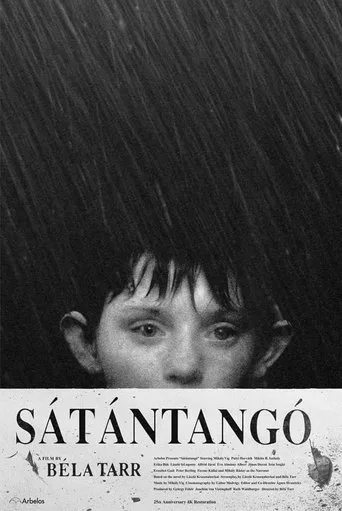
Inhabitants of a small village in Hungary deal with the effects of the fall of Communism. The town's source of revenue, a factory, has closed, and the locals, who include a doctor and three couples, await a cash payment offered in the wake of the shuttering. Irimias, a villager thought to be dead, returns and, unbeknownst to the locals, is a police informant. In a scheme, he persuades the villagers to form a commune with him.
Starring
Awards
Key opinion
Béla Tarr’s seven-hour epic is widely regarded as a monumental achievement in slow cinema, praised for its hypnotic, immersive portrayal of human degradation and decay. While its grueling pacing and bleak, non-linear structure polarize viewers, it is fundamentally seen as a profound, if exhausting, metaphysical experience.
| Cinematography | The long, uncut takes and static camera work create a unique, trance-like immersion that stretches time to mirror the characters' existential stagnation. | |
| Production | The bleak, rain-soaked landscapes and dilapidated farm settings effectively establish a hopeless, entropic atmosphere that defines the film's worldview. | |
| Score | The mournful accordion theme serves as a powerful, hypnotic anchor that underscores the film's pervasive sense of melancholy and doom. | |
| Screenplay | The non-linear, circular narrative structure is either lauded as a sophisticated, multidimensional exploration of human destiny or criticized as an exhausting, repetitive cinematic error. | |
| Runtime | The massive seven-hour runtime is a point of contention; it is celebrated by some as a necessary, transformative endurance test and rejected by others as an insufferably long ordeal. |