Trailers
 EN
EN
 Teaser
Description
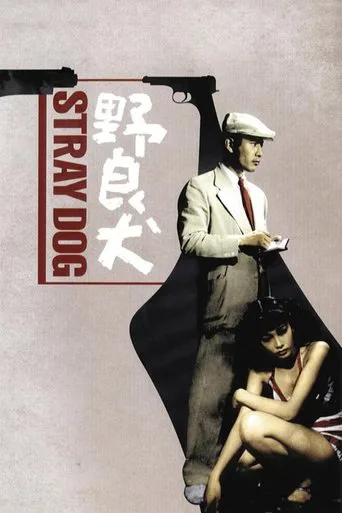
A bad day gets worse for young detective Murakami when a pickpocket steals his gun on a hot, crowded bus. Desperate to right the wrong, he goes undercover, scavenging Tokyo’s sweltering streets for the stray dog whose desperation has led him to a life of crime. With each step, cop and criminal’s lives become more intertwined and the investigation becomes an examination of Murakami’s own dark side.
Starring
Awards
Key opinion
Stray Dog is widely regarded as a seminal early work in Akira Kurosawa’s filmography that skillfully blends investigative noir with post-war social commentary. While some critics view it as a masterful, philosophical exploration of responsibility, others find the pacing sluggish and the character development somewhat underdeveloped compared to his later masterpieces.
| Culture | The film functions as a significant historical landmark that effectively synthesizes American noir, Italian neorealism, and Japanese post-war social anxieties. | |
| Direction | Kurosawa displays early mastery through expert staging and iconic sequences, such as the baseball stadium and hotel scenes. | |
| Theme | The narrative acts as a compelling character study, using the parallel lives of the detective and the criminal to explore themes of choice and personal responsibility. | |
| Pacing | The film's deliberate tempo and lengthy urban sequences are viewed by some as immersive and realistic, while others find the pacing sluggish and prone to stretching. | |
| Emotion | The emotional depth and psychological development of the central characters are praised by some as soulful and complex, while others argue they feel underdeveloped or thin. | |
| Acting | Performances are highlighted for their visual impact, though some viewers find the actual acting delivery to be inconsistent or mediocre. |