← Back to results
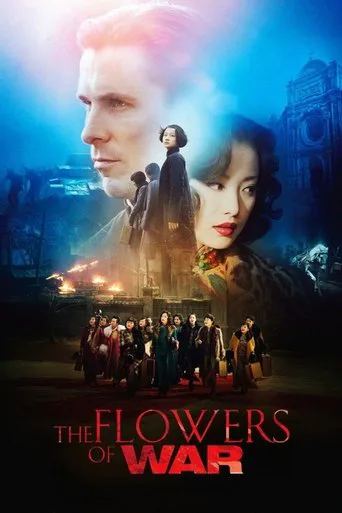
The Flowers of War
金陵十三釵
2011 146 min China, Hong Kong R 18+
★6.9
Drama, History, War
Director: Yimou Zhang
🎭 Based on
«The Flowers of War»
byGeling Yan
Trailers
Description
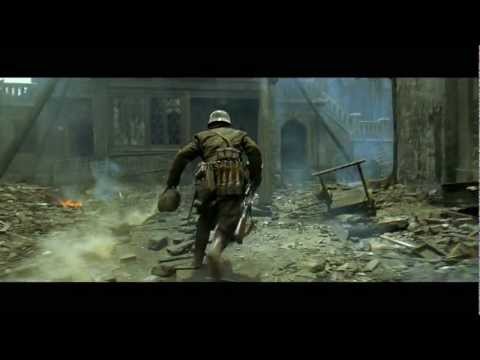
A Westerner finds refuge with a group of women in a church during Japan's rape of Nanking in 1937. Posing as a priest, he attempts to lead the women to safety.
Budget:
$94M
US Gross:
$311,434
Worldwide:
$95.31M
Starring
Christian Bale
Actor
Ni Ni
Actor
Xinyi Zhang
Actor
Awards
Asian Film Academy 2012
— Best Debut
Golden Globe 2012
— Best International Feature Film
Asian Film Academy 2012
— Best Picture
Asian Film Academy 2012
— Best Costume Design
Asian Film Academy 2012
— Best Screenplay
Asian Film Academy 2012
— Best Original Score
Asian Film Academy 2012
— Best Director
Key opinion
The Flowers of War is a visually arresting drama that earns praise for its powerful depictions of self-sacrifice and aesthetic beauty during the Nanking massacre. However, it is deeply polarizing, with critics often divided between viewing it as a poignant, transcendent exploration of humanity and dismissing it as a hollow, Hollywood-inflected melodrama that relies on manipulative sentimentality.
| Cinematography | The film utilizes high-contrast, meticulous cinematography that masterfully juxtaposes horrific violence with striking visual beauty. | |
| Acting | Christian Bale provides a grounded, transformative performance that serves as the emotional anchor for the narrative. | |
| Emotion | The film's tone is highly divisive, with some finding the blend of slow-motion spectacle and graphic atrocity profoundly moving, while others perceive it as exploitative and manipulative sentimentality. | |
| Screenplay | Opinions on the screenplay are split between those who value its tight, sequential storytelling and those who find it a clichéd, hollow imitation of Western Hollywood epics. | |
| Direction | Critics disagree on the directorial approach: proponents praise it as a return to greatness with deep attention to detail, while detractors argue it lacks a distinctly Chinese aesthetic, opting instead for a generic, commercialized perspective. |