Trailers

Description
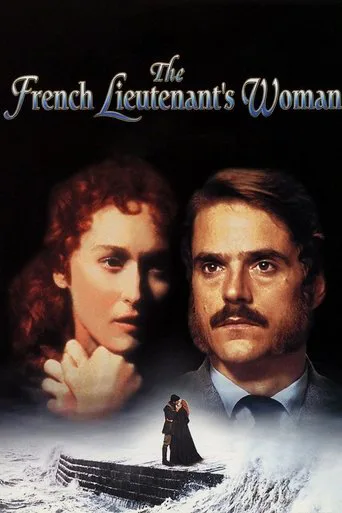
In this story-within-a-story, Anna is an actress starring opposite Mike in a period piece about the forbidden love between their respective characters, Sarah and Charles. Both actors are involved in serious relationships, but the passionate nature of the script leads to an off-camera love affair as well. While attempting to maintain their composure and professionalism, Anna and Mike struggle to come to terms with their infidelity.
Starring
Awards
Key opinion
The French Lieutenant's Woman is a polarizing adaptation that succeeds as a standalone visual drama anchored by powerful performances, though it frequently frustrates fans of the original novel. While many critics admire the ambitious dual-narrative structure as an effective translation of postmodern themes, others argue that this stylistic choice sacrifices the book's intellectual depth and character nuance.
| Acting | Meryl Streep and Jeremy Irons provide magnetic, anchor-like performances that successfully bridge the divide between the Victorian and modern timelines. | |
| Production | The film is visually elegant and authentic, with high-quality production design and sets that effectively capture the atmosphere of both the 19th century and the 1980s. | |
| Screenplay | Opinions on the screenplay are divided: supporters praise Pinter's structural innovation in mirroring the novel's postmodernism, while critics feel the script is a haphazard, hollowed-out version that abandons too many vital plot points. | |
| Adaptation | The effectiveness of the dual-timeline structure is contentious, with some finding it a compelling artistic experiment and others labeling it a distracting gimmick that undermines the emotional core of the Victorian romance. | |
| Pacing | The film's pacing is a subject of disagreement, viewed by some as a slow-burn narrative that rewards patience and by others as sluggish and lacking in dramatic momentum. |