← Back to results
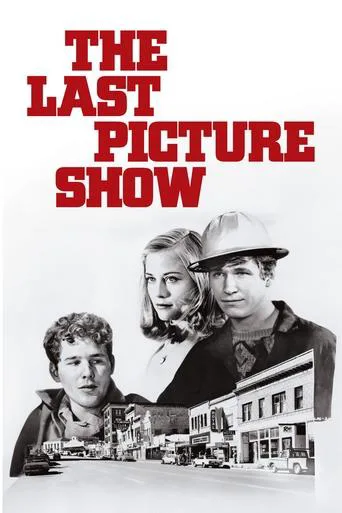
The Last Picture Show
1971 119 min United States of America R 16+
★8.8
Drama, Romance
Director: Peter Bogdanovich
📖 Based on the novel
«The Last Picture Show»
byLarry McMurtry
Trailers

 EN
EN
 EN
EN
 EN
EN
 EN
EN
 EN
EN
 EN
EN
 EN
EN
 EN
EN
Description
High school seniors and best friends, Sonny and Duane, live in a dying Texas town. The handsome Duane is dating a local beauty, while Sonny is having an affair with the coach's wife. As graduation nears and both boys contemplate their futures, Duane eyes the army and Sonny takes over a local business. Each struggles to figure out if he can escape this dead-end town and build a better life somewhere else.
Budget:
$1.3M
US Gross:
$29.13M
Worldwide:
$29.13M
Starring
Timothy Bottoms
Actor
Jeff Bridges
Actor
Cybill Shepherd
Actor
Awards
BAFTA 1973
— Best Screenplay
BAFTA 1973
— Best Supporting Actor
Golden Globe 1972
— Best Supporting Actor
Academy Awards 1972
— Best Adapted Screenplay
Academy Awards 1972
— Best Director
BAFTA 1973
— Best Screenplay
BAFTA 1973
— Best Director
Golden Globe 1972
— Best Director
BAFTA 1973
— Best Supporting Actor
Golden Globe 1972
— Best Supporting Actress
Golden Globe 1972
— Best Picture (Drama)
Golden Globe 1972
— Best Female Debut
Academy Awards 1972
— Best Supporting Actor
Golden Globe 1972
— Best Supporting Actor
BAFTA 1973
— Best Picture
BAFTA 1973
— Best Supporting Actress
Key opinion
The Last Picture Show is widely regarded as a melancholic and authentic masterpiece of New Hollywood cinema. While praised for its evocative black-and-white cinematography and strong performances, some viewers find its pacing and focus on sexual themes either polarizing or overly academic.
| Cinematography | The black-and-white cinematography masterfully captures the stark, dusty atmosphere of a declining Texas town. | |
| Acting | The film features powerful, career-defining performances from the supporting cast, particularly Ben Johnson and Cloris Leachman. | |
| Screenplay | The screenplay by Larry McMurtry provides honest, sharp dialogue that effectively portrays the disillusionment of youth. | |
| Pacing | The pacing is viewed either as a deliberate, atmospheric reward for the contemplative viewer or as a fragmented, miniseries-like experience. | |
| Theme | The explicit focus on teenage sexual experimentation is seen by some as an essential, realistic component of coming-of-age, while others find it excessive or lacking in genuine emotional warmth. |