← Back to results
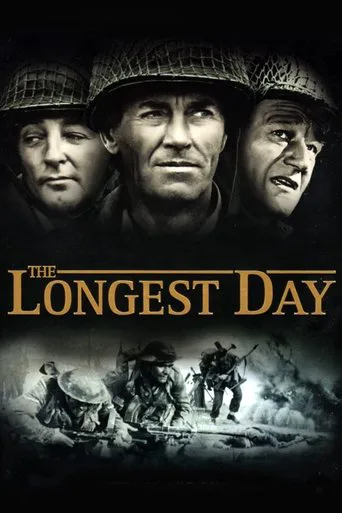
The Longest Day
1962 178 min United States of America PG 16+
★8.1
War, Action, Drama
Director: Ken Annakin, Andrew Marton, Gerd Oswald
🎭 Based on
«The Longest Day»
byCornelius Ryan
Trailers
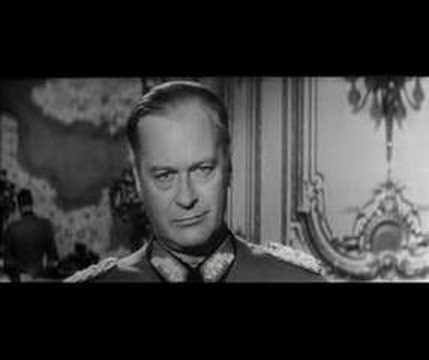
 EN
EN
 EN
EN
Description
The retelling of June 6, 1944, from the perspectives of the Germans, US, British, Canadians, and the Free French. Marshall Erwin Rommel, touring the defenses being established as part of the Reich's Atlantic Wall, notes to his officers that when the Allied invasion comes they must be stopped on the beach. "For the Allies as well as the Germans, it will be the longest day"
Budget:
$10M
Worldwide:
$50.1M
Starring
John Wayne
Actor
Robert Ryan
Actor
Richard Burton
Actor
Awards
Golden Globe 1963
— Best Cinematography (Black and White)
Academy Awards 1963
— Best Visual Effects
Academy Awards 1963
— Best Cinematography (Black and White)
Academy Awards 1963
— Best Visual Effects
Academy Awards 1963
— Best Production Design (Black and White)
Academy Awards 1963
— Best Film Editing
Academy Awards 1963
— Best Cinematography (Black and White)
Key opinion
The Longest Day is widely recognized as a foundational, ambitious war epic that provides a grand, multi-perspective chronicle of D-Day through its technical scale and international cast. While many praise its historical scope and authentic production design, others find the film's sprawling, character-light structure emotionally distant and dramatically uneven.
| Acting | The massive, multi-national ensemble cast provides a panoramic look at the invasion, though it frequently leads to underdeveloped characters and a lack of a central protagonist. | |
| Production | The production effectively utilizes authentic locations and impressive large-scale stunts to create a historically immersive atmosphere that set a benchmark for war cinema. | |
| Runtime | The three-hour runtime allows for an exhaustive, detailed chronicling of the day's events, but it creates a detached, documentary-like experience that some find tedious or exhausting. | |
| Theme | The film succeeds in delivering a balanced, impartial portrayal of both Allied and German perspectives rather than relying on standard wartime archetypes. | |
| Humor | Occasional instances of light-hearted moments and dark humor serve to humanize the soldiers and effectively offset the grim reality of the combat sequences. | |
| Adaptation | The combat sequences and death depictions are frequently viewed as sanitized, choreographed, or overly theatrical compared to the gritty, visceral realism of later modern war films. |