← Back to results
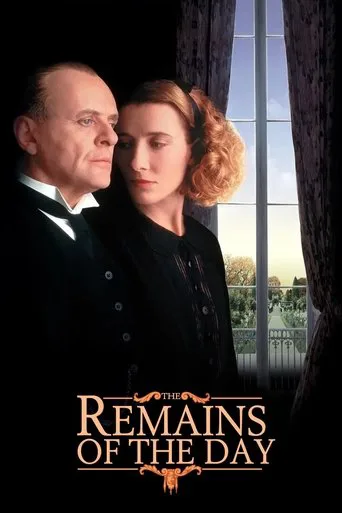
The Remains of the Day
1993 134 min United Kingdom, United States of America PG 18+
★8.3
Drama, Romance
Director: James Ivory
🎭 Based on
«The Remains of the Day»
byKazuo Ishiguro
Trailers

 EN
EN
 EN
EN
 EN
EN
 EN
EN
 EN
EN
Description
A rule-bound head butler's world of manners and decorum in the household he maintains is tested by the arrival of a housekeeper who falls in love with him in post-WWI Britain. The possibility of romance and his master's cultivation of ties with the Nazi cause challenge his carefully maintained veneer of servitude.
Budget:
$11.5M
US Gross:
$23.24M
Worldwide:
$23.24M
Starring
Anthony Hopkins
Actor
Emma Thompson
Actor
John Haycraft
Actor
Awards
Academy Awards 1994
— Best Director
Golden Globe 1994
— Best Actor (Drama)
Academy Awards 1994
— Best Original Score
Academy Awards 1994
— Best Costume Design
Academy Awards 1994
— Best Actor
Goya Awards 1995
— Best European Film
Academy Awards 1994
— Best Actress
BAFTA 1994
— Best Picture
BAFTA 1994
— Best Actor
BAFTA 1994
— Best Adapted Screenplay
BAFTA 1994
— Best Cinematography
Academy Awards 1994
— Best Adapted Screenplay
Academy Awards 1994
— Best Production Design
Golden Globe 1994
— Best Actress (Drama)
Golden Globe 1994
— Best Director
BAFTA 1994
— Best Actress
BAFTA 1994
— David Lean Award for Direction
Academy Awards 1994
— Best Picture
Golden Globe 1994
— Best Picture (Drama)
Golden Globe 1994
— Best Screenplay
Key opinion
The Remains of the Day is widely praised as a masterclass in restrained, character-driven filmmaking, anchored by Anthony Hopkins’ deeply nuanced performance. While some viewers find its deliberate, meditative pacing challenging, most critics and audiences appreciate how the film uses the backdrop of interwar British aristocracy to explore the tragic costs of absolute professional devotion.
| Acting | Anthony Hopkins delivers a powerful, understated performance that perfectly captures the internal conflict of a man prioritizing duty over personal fulfillment. | |
| Production | The meticulous production design and authentic interior settings successfully immerse the viewer in the atmosphere of a fading British estate. | |
| Theme | The film’s thematic depth effectively juxtaposes the rigid, self-denying nature of aristocratic service against the looming moral failings of the pre-WWII political elite. | |
| Pacing | The contemplative, slow-burning pace is viewed by some as an essential requirement for building atmospheric immersion, while others find it to be an exhausting and uneventful experience. | |
| Adaptation | The adaptation of Ishiguro’s novel is debated; some praise its faithful capture of psychological ambiguity, while others argue the transition to film lacks the necessary narrative drive to remain compelling. |